Skip to the content

Private preview: sign-up is not open yet. Join the waitlist

tennet
Private preview

A software team of people and named AI specialists, in one room.

Describe what you want. The lead agent asks what it needs, proposes a plan with its cost, and builds nothing until you approve. Then specialists take turns, prove each change in a real browser, hand off with the facts, and stop to listen the moment you speak.
Measured: a first preview in 72.6 s and US$0.102 in model cost per app, medians of 30 frozen briefs (Quick build, Nov 22, 2026). How we measure

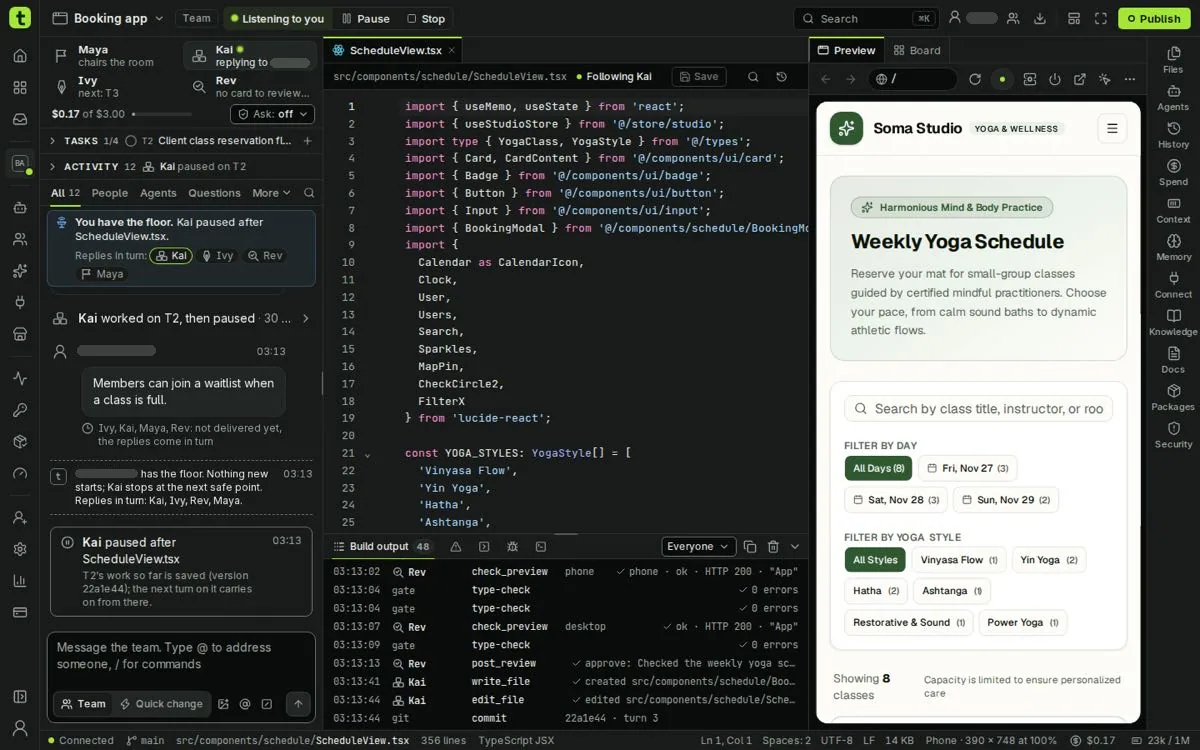
A person speaks mid-build: the room shows they have the floor, Kai stops after the file he was writing and saves version 22a1e44, and replies will come in turn from Kai, Ivy, Rev and Maya. The code, the build output with Rev's checks and the live phone preview sit beside the thread.
The Theatre while a person has the floor. Screenshot from Tennet's own browser tests, Nov 25-27, 2026 (round 8 build, the console's previous look); names masked.
Team room · Booking app
A person speaks mid-build: the room shows they have the floor, Kai stops after the file he was writing and saves version 22a1e44, and replies will come in turn from Kai, Ivy, Rev and Maya. The code, the build output with Rev's checks and the live phone preview sit beside the thread.
for the writing agent to stop when a person speaks
Bar 15 s · 2 reads, Nov 27, 2026
for an accepted change of plan to reach the board
Bar 2 s · 3 reads, Nov 27, 2026
agent lines, each a billed model call, 0 scripted
phase 1 exit read, Nov 22, 2026
access checks on the deployed server (3,412 answers, 9 kinds of caller, 0 mismatches)
every route, Nov 27, 2026

The ecosystem

One workspace, one board, one room

People and teams of named AI specialists build software together: shared workspaces, one board for the plan, and one room where everyone works in the open.

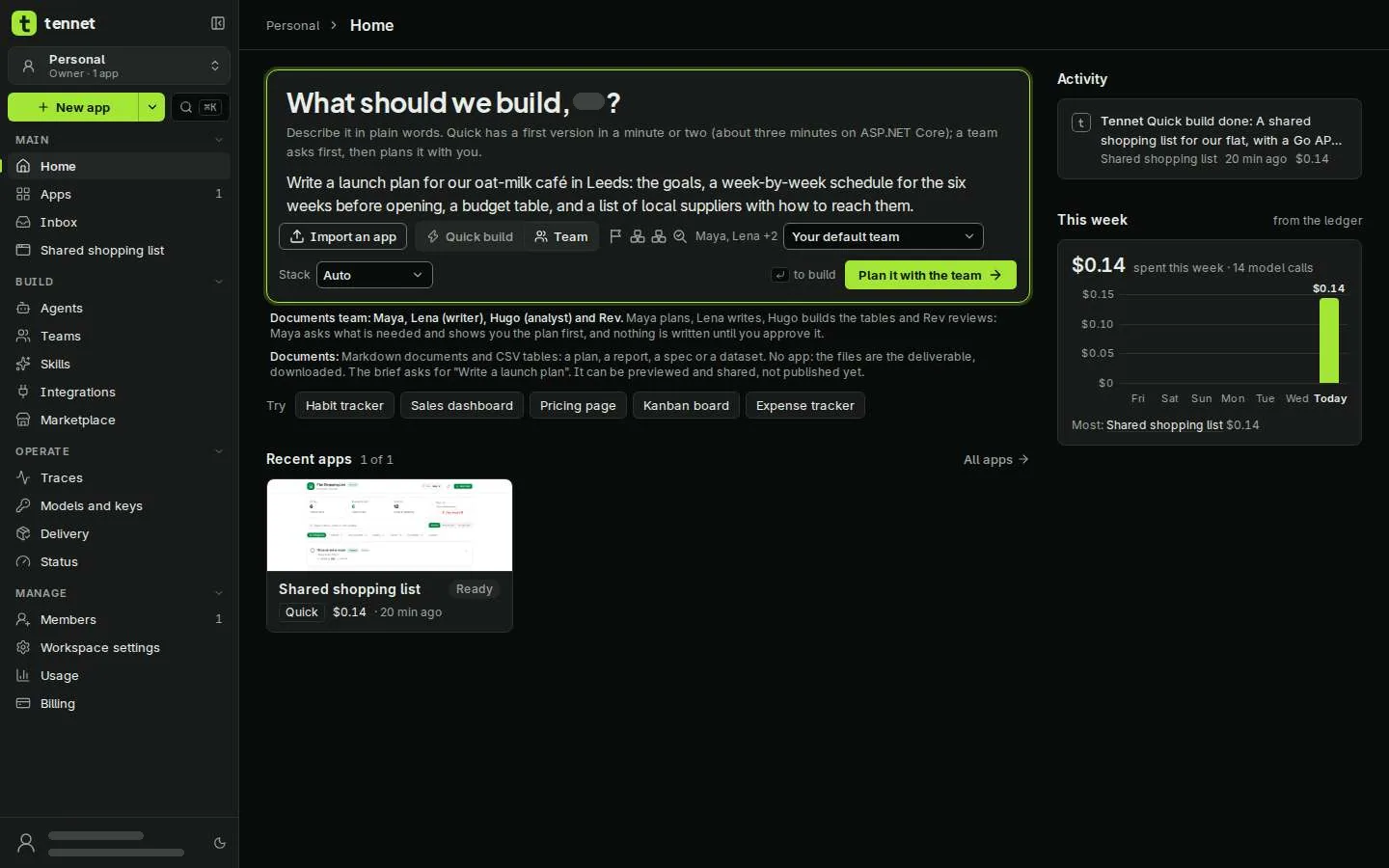
Team mode on Home with a writing brief: Auto picks the Documents stack and names the team before anything starts: Maya plans, Lena writes, Hugo builds the tables and Rev reviews.

Workspaces

Shared workspaces with six roles. Two people can work in one room: each sees the other, every instruction is attributed by name, and conflicting instructions raise a conflict card both see.

Two people in one room: 23 of 23 checks passed (scenario C13, Nov 27, 2026)

Explore workspaces and access
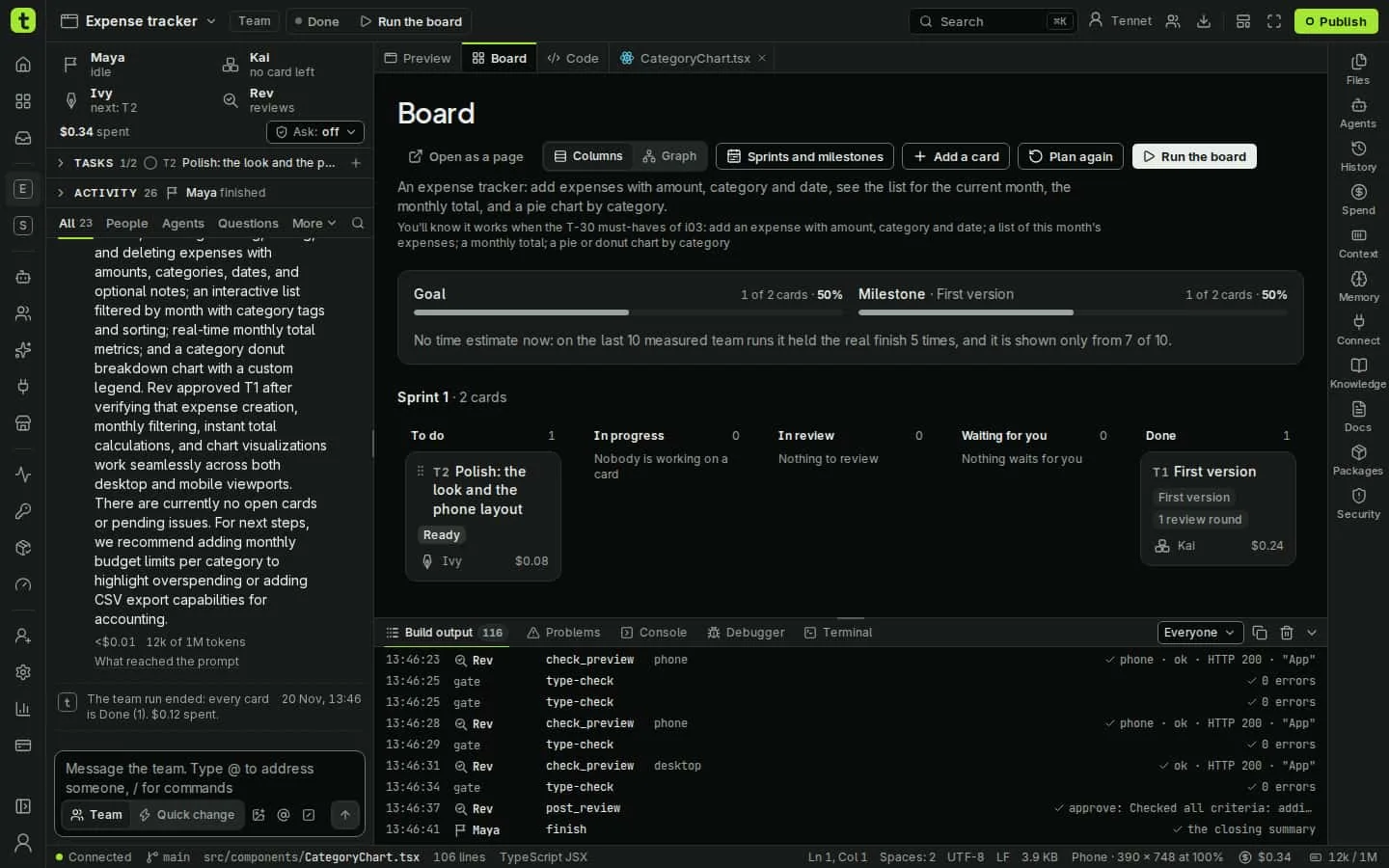
The board of an expense tracker: goal and milestone each 1 of 2 cards, card T1 Done after one review round at US$0.24, card T2 ready for Ivy at US$0.08, and the time estimate withheld because it held only 5 of the last 10 runs.

The board

A goal, a milestone, sprints, and cards that each carry acceptance criteria, an owner and a cost, shown as five columns or a dependency graph.

A time estimate shows only once it held on 7 of 10 of the last measured runs

Explore the board
A person speaks mid-build: the room shows they have the floor, Kai stops after the file he was writing and saves version 22a1e44, and replies will come in turn from Kai, Ivy, Rev and Maya. The code, the build output with Rev's checks and the live phone preview sit beside the thread.

The Theatre

The thread, the team strip, the live preview, the board and the code, side by side. Agents take turns, hand off with real context, ask questions, and stop to listen when you speak.

Every agent line is a billed model call: 3,707 of 3,707

Explore the Theatre

Team mode

How a team run works

From a sentence to a running app, one turn at a time. Code, not a model, decides whose turn it is.

Schematic. Seat names are the product's default team; turn rules are the product's own.
  1. You describe it. In English or another language; Auto picks a stack and says why.
  2. The lead asks. Each question has options, a default and a deadline.
  3. The plan is a contract. Goal, milestone, sprint and cards with criteria, owners and cost.
  4. You approve. Nothing is built before you do.
  1. A turn. Intent first, then the build, then proof on a desktop and a 390 px phone, then a commit.
  2. The handoff. What was built, which files, what to watch for and the gate's evidence.
  3. The review. A reviewer that did not write it reads the diff and talks back.
  4. Done, only when the gate passed, the review approved, a file changed and you accepted where asked.

Floor When you speak, everyone stops. The floor is yours within seconds, the writer stops at a safe point, replies come in turn, and the lead proposes changes as ghost cards. You decide.

Explore Team mode

Agents

Meet the seats

An agent is a persona, skills and memory. Tennet trains no model on anyone's code.

Maya · lead

Asks what she needs, writes the plan with its cost, never writes code.

Kai · builder

Says what he will change, builds it, proves it, commits.

Rev · reviewer

Reads every diff on both screen sizes and talks back.

Ivy · designer

The look and the phone layout, on Squad teams.

Quinn · QA

Turns each card's criteria into tests that code runs.

Specialists that stacks bring

  • Omar backend
  • Dana database
  • Lena writer
  • Hugo analyst
  • Rio phone apps
  • Sena site reliability

Templates: Starter seats a lead, a builder and a reviewer; Squad adds a designer and QA; Agency waits for your acceptance on each card. Default caps: a turn US$0.40, a run US$3.

The floor

Stop and listen

Write in the room at any time. Tennet reads your message as an answer, an ask, a direct instruction or a discussion.

Nothing new starts within 2 seconds, and the writer stops within 15 seconds at a safe point and saves its work as a commit.

The agents reply in turn, each seeing the replies before it. The lead, last, proposes typed changes as dashed ghost cards with their cost.

A change that edits no card and adds at most US$0.20 carries on at once; anything else waits for Apply, Edit, Keep plan or Stop. No timer ever decides.
Measured: the writer stopped in 4.2-10.8 s (bar 15 s); an applied change reached the board in 572-980 ms (bar 2 s), Nov 27, 2026.

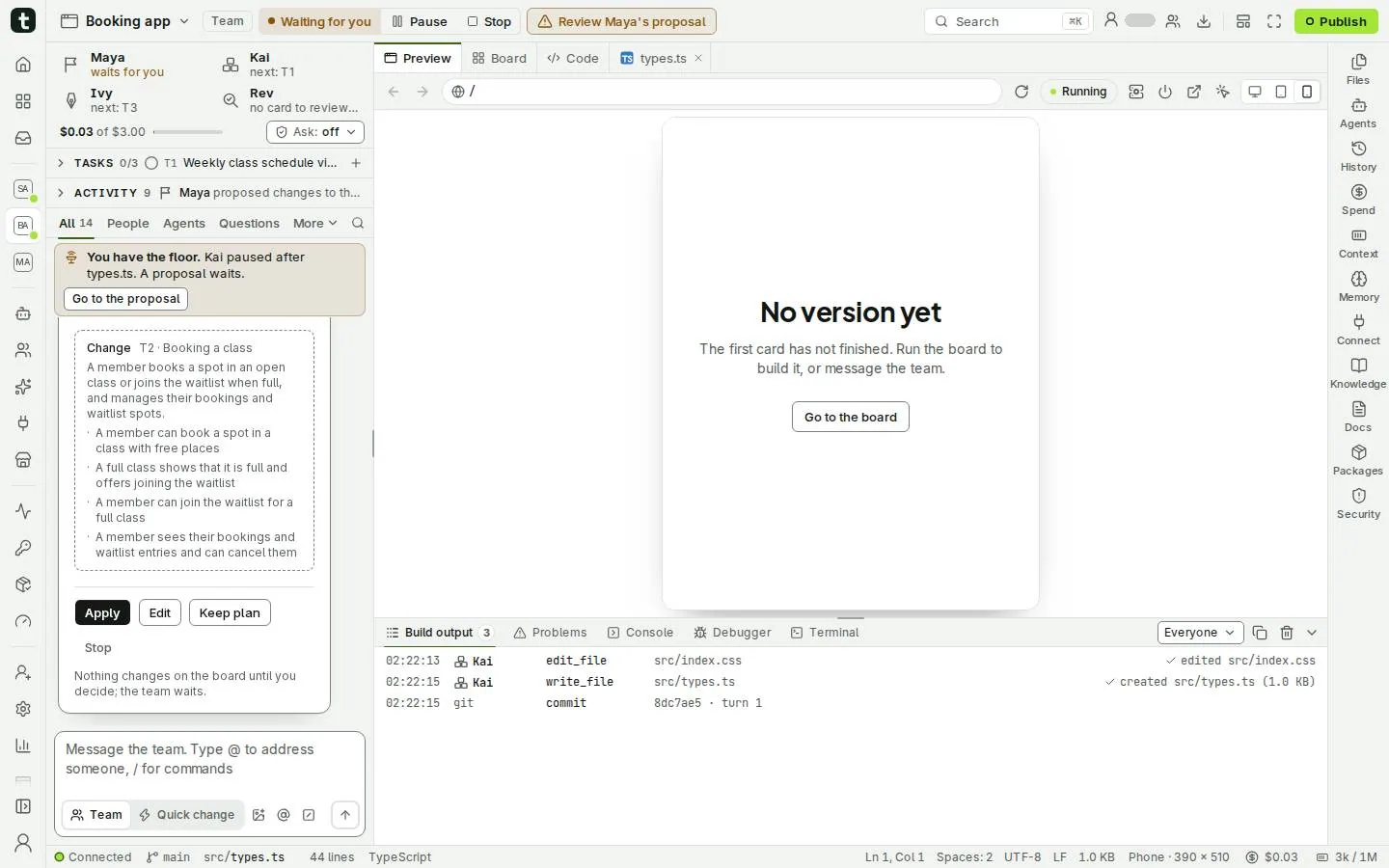
The lead's proposal arrives as a dashed ghost card: card T2, Booking a class, rewritten with four acceptance criteria. Apply, Edit, Keep plan or Stop; nothing changes on the board until the person decides.
A ghost card waits for your decision. Screenshot from Tennet's own browser tests, Nov 25-27, 2026 (round 8 build, the console's previous look); names masked.
  1. Maya waits for you. The lead has proposed a change; the team waits.
  2. You have the floor. Kai paused after types.ts. A proposal waits.
  3. A typed change. T2 rewritten with four acceptance criteria that bring in the waitlist.
  4. You decide. Apply, Edit, Keep plan or Stop. No timer ever decides.
Team room · Proposal
The lead's proposal arrives as a dashed ghost card: card T2, Booking a class, rewritten with four acceptance criteria. Apply, Edit, Keep plan or Stop; nothing changes on the board until the person decides.

One engine

Two ways to build, on one engine

Start with the team, or start alone with Quick build and bring in the team at any point. A test hashes every Quick request, so team features can never change Quick.

Team mode

A lead, specialists and a reviewer take turns on a plan you approved, over one board, in one room.

  1. Brief
  2. Questions
  3. Plan
  4. Approve
  5. Turns
  6. Done
First preview, median
94.4 s (bar 120 s)
Team build, median
US$0.287 (bar US$0.80)

Phase 1 exit read, Nov 21, 2026

Quick build

One agent, one brief, a first version in a minute or two. Keep talking to change it; each change is a version.

  1. Brief
  2. One agent
  3. Checks
  4. Version
  5. Change
First preview, median
72.6 s
Model cost per app, median
US$0.102

30 frozen briefs, T-30 full run 7, Nov 22, 2026

Bring in the team at any point: a Quick app switches to Team mode with one choice.

The dashboard

Everything in the room

Every module of the dashboard, in the order of its own navigation, with its status today.

Displaying 24 of 24 modules

Home

One prompt box, Quick build or Team, the Stack menu, the team named before anything starts, and what is running now.
In previewMain

Apps

Every app as a grid or a table, with a peek pane. Deleted projects wait 7 days in a trash.
In previewMain

Inbox

Questions, approvals, conflicts and decisions waiting for you, and what happened while you were away.
In previewMain

Agents

Named specialists with a persona, tools, skills, memory and a track record read from the database.
In previewBuild

Teams

Starter, Squad and Agency templates, default caps per turn and per run, and the working agreement.
In previewBuild

Skills

Packs of instructions with files, triggers and versions that reach only their agent or team.
In previewBuild

Integrations

Connected apps, MCP servers, signed webhooks and schedules. Agents use a tool only when you allow it.
In previewBuild

Marketplace

Agents and skills listed with what they measurably did on Tennet, scored from the rows on every read.
In previewBuild

Traces

Every model call with its run, model, tokens, cost and payer; one run's turns and tools in order.
In previewOperate

Models and keys

Bring your own Gemini key: checked live, sealed, shown by its last four characters.
In previewOperate

Delivery

Cards done, time to Done, pass rate and cost per card by week. Viewers see it without the money.
In previewOperate

Status

Whether each Tennet service works now, from samples every 30 seconds, with uptime and down spells.
In previewOperate

Members

Invite people, set workspace and project roles, seat a client as an approver.
In previewManage

Workspace settings

The workspace, its sign-in rule, two-step sign-in and erasure.
In previewManage

Usage

Spend by member, project, agent and model, and the caps every call is held against.
In previewManage

Billing

Plans and prices are not set; the page says so and offers nothing to buy.
ComingManage

Organization

Caps over every workspace, single sign-on with OIDC and SAML 2.0, and what all of them spent.
In previewManage

Resources

Every sandbox, terminal, published app and share link of the workspace, each stoppable.
In previewManage

API keys

Keys that act as you inside one workspace, shown once and stored as a hash.
In previewManage

Audit log

One row per action, with who did it and when, in plain words.
In previewManage

Theatre

The project's one room: thread, team strip, live preview, board and code side by side.
In previewThe project

Board

Goals, milestones, sprints and cards with criteria, owners and cost, as columns or a graph.
In previewThe project

Connections

A project's repository, webhooks, schedules and triggers.
In previewThe project

Publish and Production

Versions, rollback, share links, health checks, figures, logs and alerts.
In previewThe project

Stacks

What you can build

Each stack opens only after its own suite passes, and closes again when its files change.

Frontend

Frontend

In preview

React in the browser.

Suite it passed
T-30
Services
None needed
Publishes
Yes, as a static app
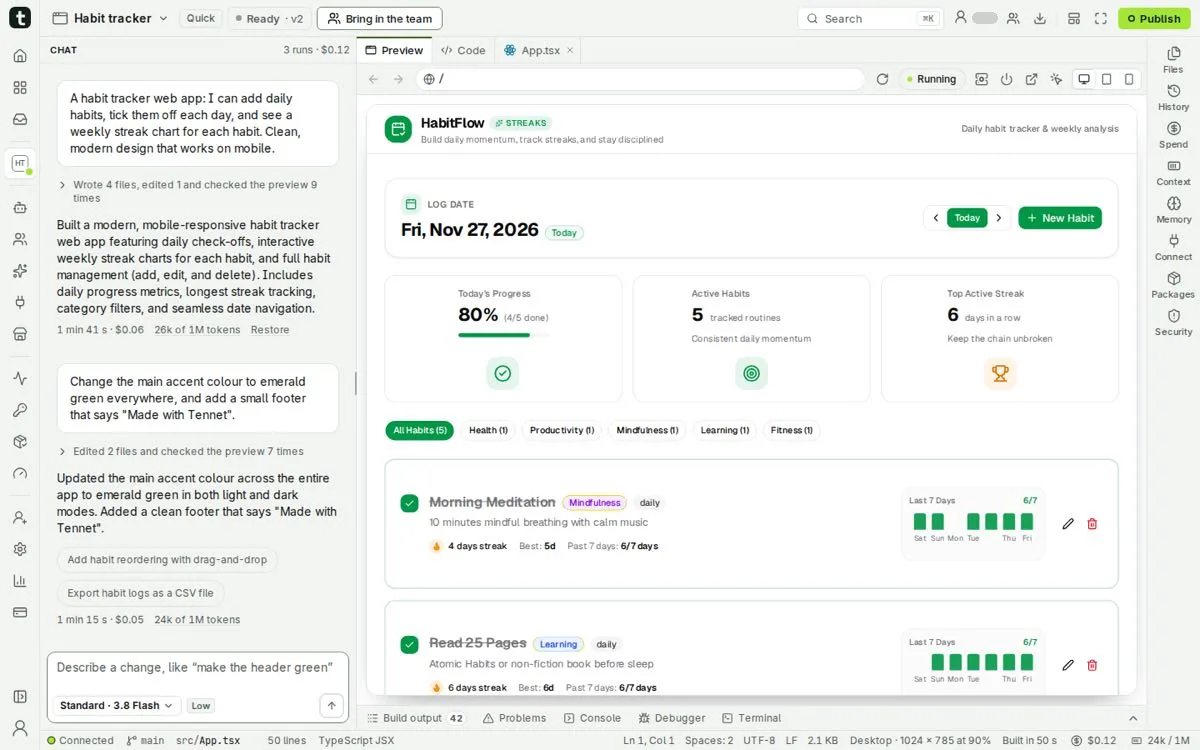
A Quick build of a habit tracker: first version in 1 min 41 s for US$0.06, a change in 1 min 15 s for US$0.05, each turn with its tokens and a Restore button, and Bring in the team.
A Quick build with two versions you can restore. Screenshot from Tennet's own browser tests, Nov 25-27, 2026 (round 8 build, the console's previous look); names masked.
Quick build · Habit tracker
A Quick build of a habit tracker: first version in 1 min 41 s for US$0.06, a change in 1 min 15 s for US$0.05, each turn with its tokens and a Restore button, and Bring in the team.
Full-stack

Full-stack

In preview

React, a Hono API and seven app services.
Suite it passed
FS-6
Services
Postgres, MariaDB, FerretDB, Valkey, SeaweedFS, Mailpit, the app's own AI
Publishes
Yes
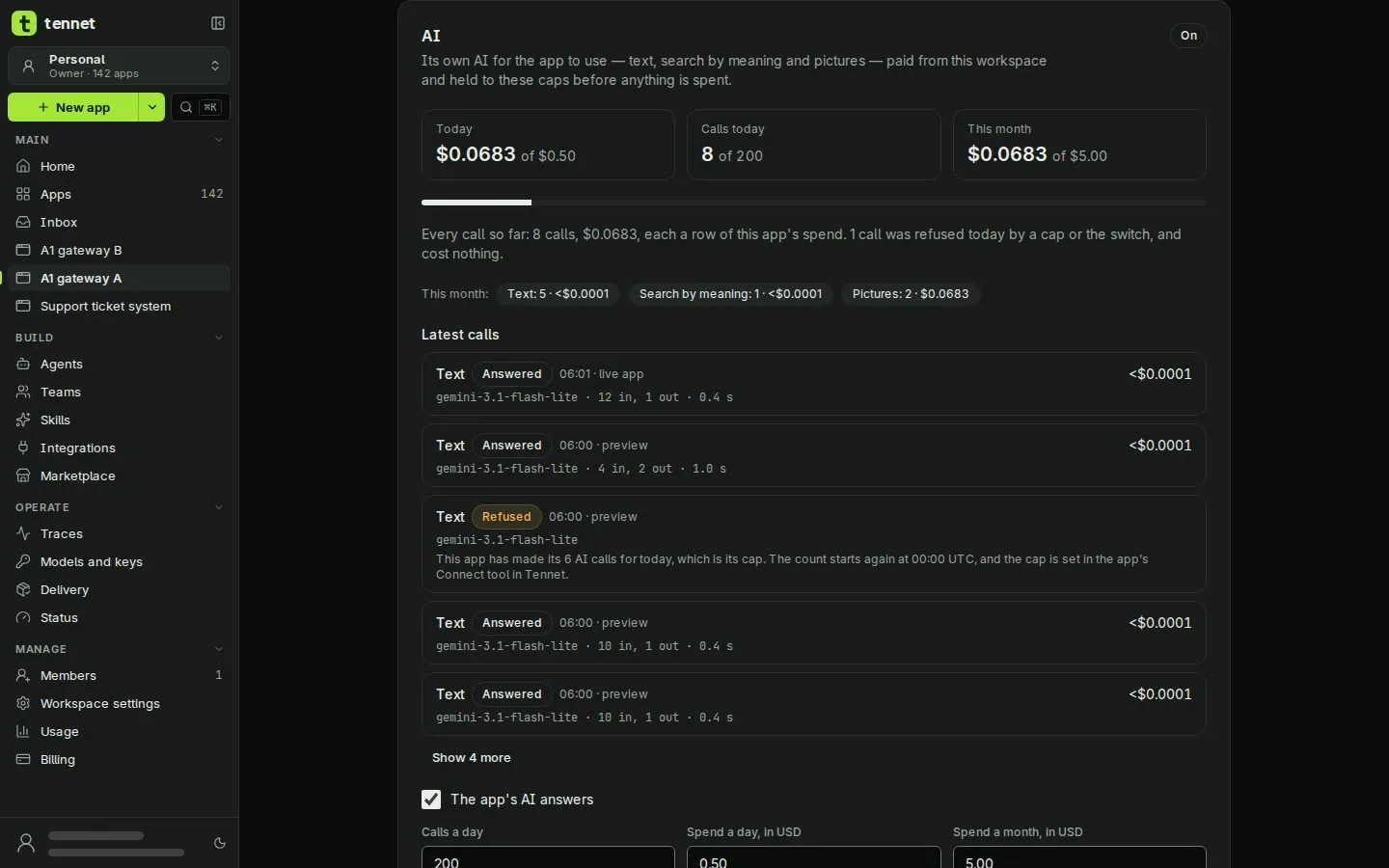
Each app's own AI: US$0.0683 of US$0.50 today and 8 of 200 calls; every call a line of the app's spend; the one refused call cost nothing.
An app's AI calls held to its caps. Screenshot from Tennet's own browser tests, Nov 25-27, 2026 (round 8 build, the console's previous look); names masked.
The app's own AI
Each app's own AI: US$0.0683 of US$0.50 today and 8 of 200 calls; every call a line of the app's spend; the one refused call cost nothing.
Python

Python

In preview

React, FastAPI and Postgres.

Suite it passed
PY-6
Services
Postgres
Publishes
Not yet: live preview and share links
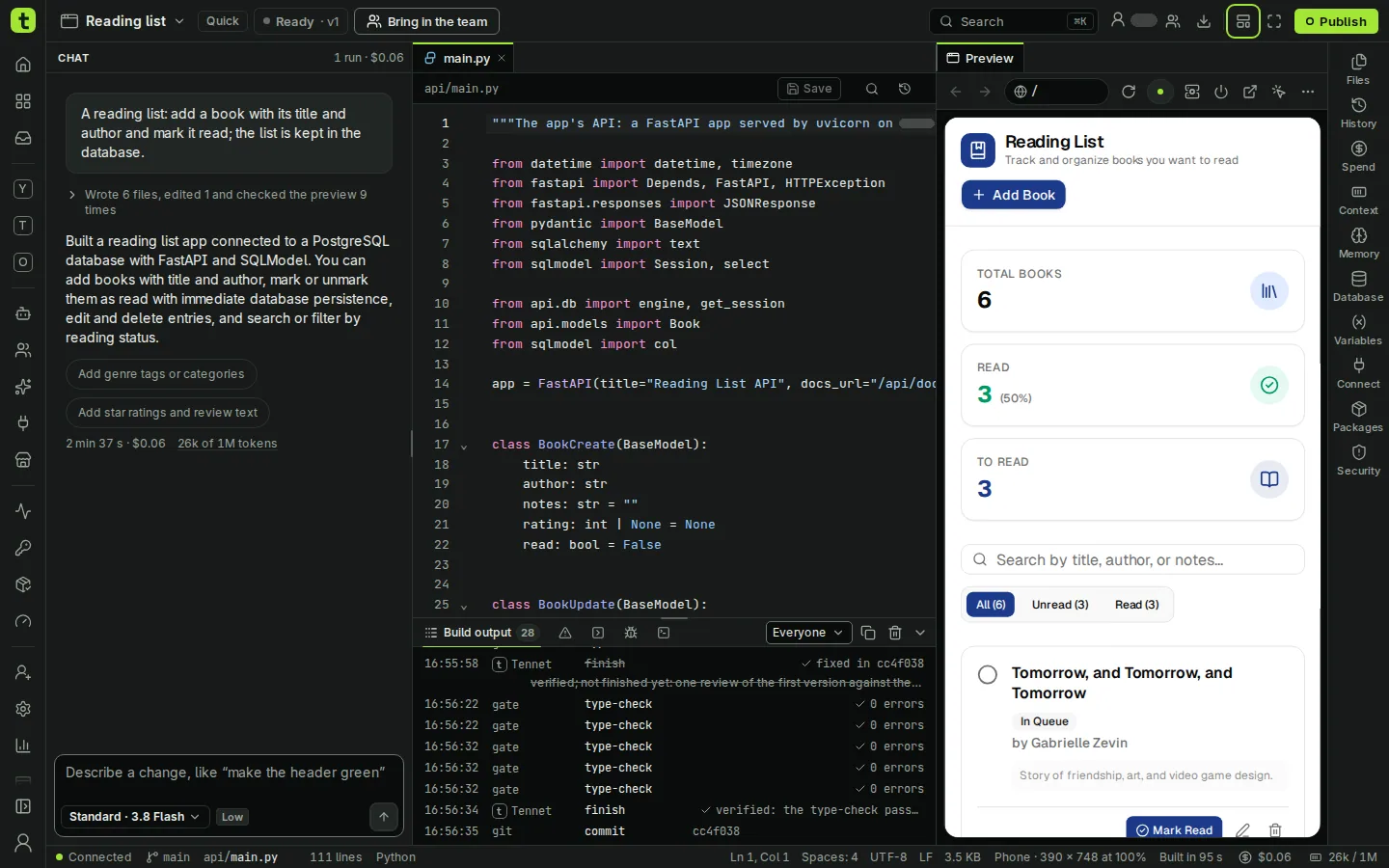
The workbench on a Python app: the brief and summary on the left, the FastAPI code in the editor, the gate's type-checks in the build output, and the app in the preview at phone width.
The workbench on a Python (FastAPI) app. Screenshot from Tennet's own browser tests, Nov 25-27, 2026 (round 8 build, the console's previous look); names masked.
Workbench · Python app
The workbench on a Python app: the brief and summary on the left, the FastAPI code in the editor, the gate's type-checks in the build output, and the app in the preview at phone width.
MERN

MERN

In preview

React, Express and FerretDB (Mongo-compatible).

Suite it passed
MN-6
Services
FerretDB
Publishes
Not yet: live preview and share links
Documents

Documents

In preview

Markdown documents and CSV tables.

Suite it passed
DOC-6
Services
None
Publishes
Download, by design
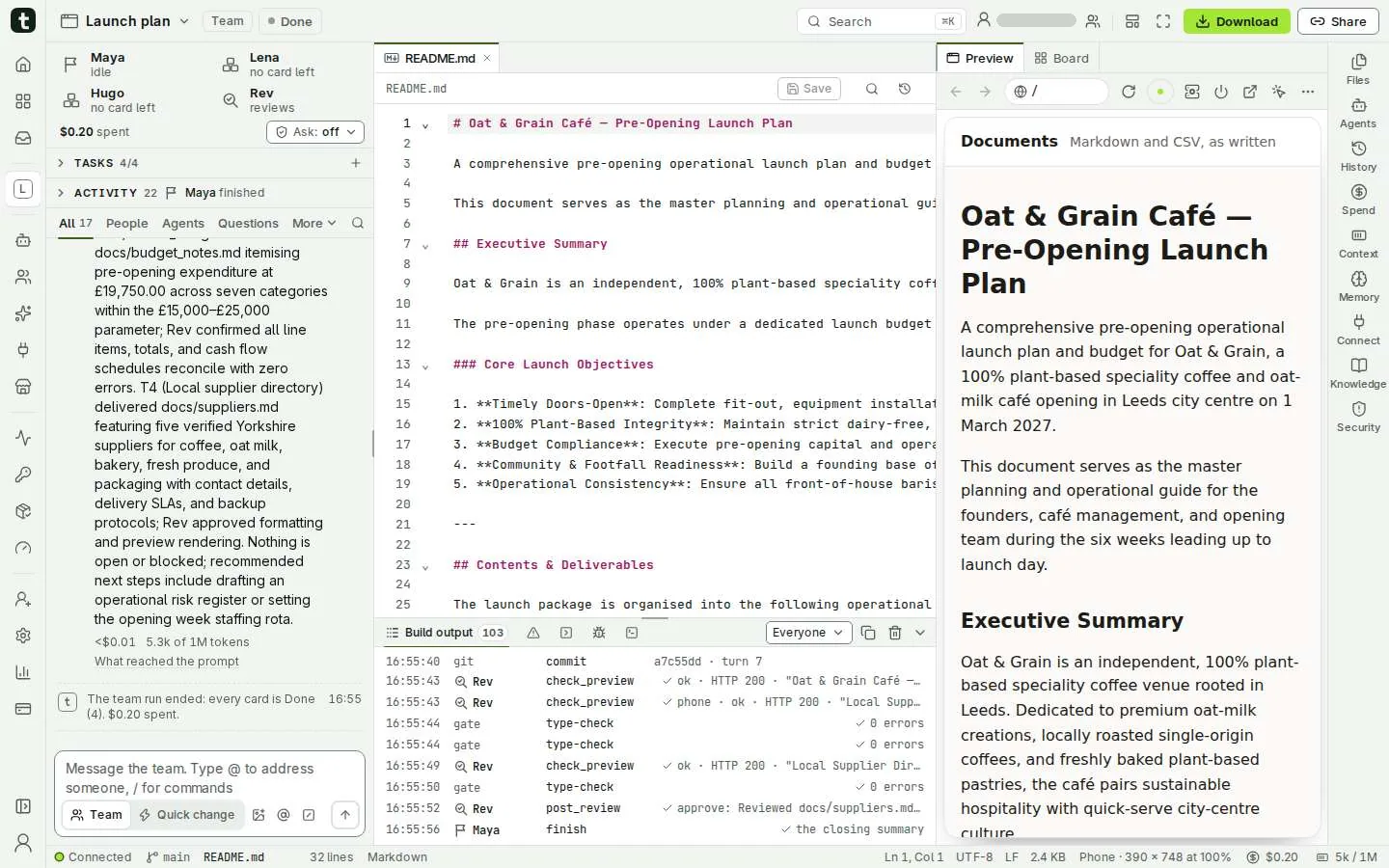
A Documents project: a café's pre-opening launch plan written by Lena and Hugo and reviewed by Rev; four cards, US$0.20 in all; Download and Share instead of Publish.
A Documents project written by the team. Screenshot from Tennet's own browser tests, Nov 25-27, 2026 (round 8 build, the console's previous look); names masked.
Documents project
A Documents project: a café's pre-opening launch plan written by Lena and Hugo and reviewed by Rev; four cards, US$0.20 in all; Download and Share instead of Publish.
Mobile app

Mobile app

In preview

Expo (React Native), an API and Postgres, in a phone frame.

Suite it passed
EX-7
Services
Postgres
Publishes
Its web build

No app-store build or submission.

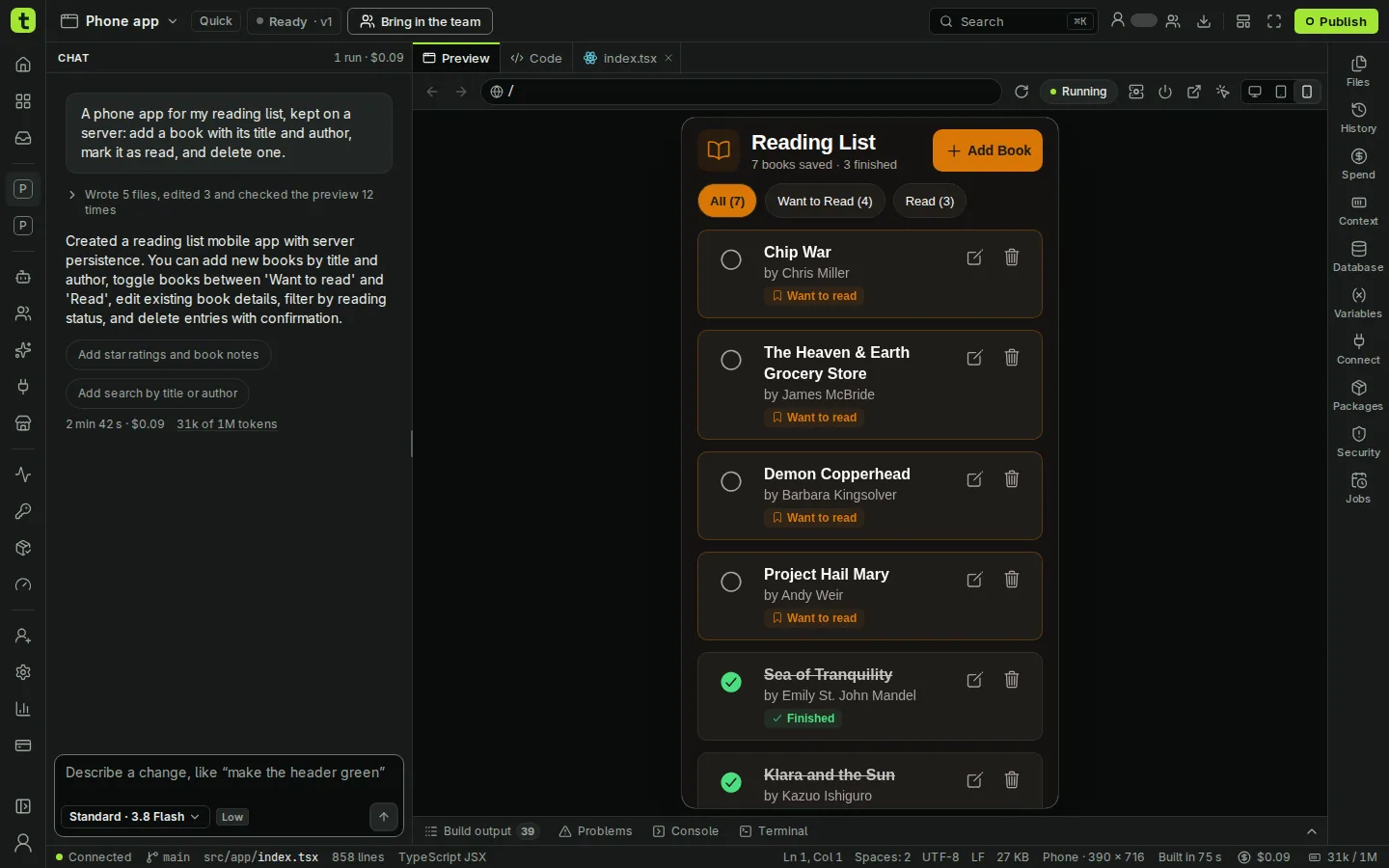
A phone app built with Quick build on the Mobile app stack: an Expo reading list kept on a server, in a phone frame in the preview; 2 min 42 s and US$0.09.
An Expo app in the phone frame. Screenshot from Tennet's own browser tests, Nov 25-27, 2026 (round 8 build, the console's previous look); names masked.
Mobile app · Expo
A phone app built with Quick build on the Mobile app stack: an Expo reading list kept on a server, in a phone frame in the preview; 2 min 42 s and US$0.09.
ASP.NET Core

ASP.NET Core

In preview

React, a C# minimal API and EF Core.

Suite it passed
AN-6
Services
Postgres
Publishes
Yes, as a container
Rails

Rails

In preview

React and a Rails 8 API.

Suite it passed
RL-6
Services
Postgres
Publishes
Yes, as a container
Nuxt

Nuxt

In preview

Vue 3, Nuxt 4 and Postgres.

Suite it passed
NU-6
Services
Postgres
Publishes
Yes, as a container
In verification, re-measuring and coming

The rest of the table

  • Go

    React, a Go API and Postgres

    In verification
  • Laravel

    React, Laravel 13 and MariaDB

    In verification
  • Static HTML

    One page, no build step

    Re-measuring
  • Rust

    React, axum and sqlx

    Re-measuring
  • Next.js

    App Router and Postgres

    Re-measuring
  • SvelteKit

    Svelte

    Coming
  • Angular

    Angular and a Hono API

    Coming
  • WordPress

    A block theme and a site plugin, MariaDB

    Coming
  • Spring Boot

    A Java 25 API, Spring Data JPA and Flyway

    Coming

Quality

Proven before it is done

A feature that only unit tests prove is not done. Every turn is checked in a real browser, and every round meets written bars before it goes live.

Checked in a real browser

Every turn ends with a type-check and the app loaded on a desktop and at 390 px phone width.

Read by a reviewer that did not write it

The review reads each card's diff on both screen sizes; findings go back into the author's next prompt.

Done means done

The gate passed, the review approved, at least one file changed, no write was cut off, and you accepted where asked.
  • Access checks on the deployed server479 of 479 · 9 kinds of callerPassed
  • Accessibility, axe-core on every signed-in page0 serious, 0 critical · 426 readingsPassed
  • Phone sweep at four widths636 screenshots, 0 wider than the screenPassed
  • Automated suite at promotion4,797 passed, 0 failedPassed

Round 8's promotion read, Nov 27, 2026. Every figure in the register

Your code, keys and data stay apart

  • A gVisor sandbox per project2 CPUs, 2 GB, every capability dropped, a network fence.
  • Model keys never in a sandbox or a promptThey stay in Tennet's worker.
  • Secrets sealed with AES-256-GCMEach bound to its row; never shown again after it is set.
  • Previews behind signed, short-lived grantsTied to your access, checked on every request.
  • Every call reserved against its capsBefore it is made; a refusal names the cap.
  • Export at any timeA ZIP of the code, or a container image.

Tennet holds no security certification today.

Ship it

Publish

A first version live in 6,029 ms, with every version kept and private share links.

Roll back

In under 1 ms: one routing entry changes, and the same bytes come back by checksum.

Take it away

A 71 MB container image built in 2,663 ms, with a compose file.

Deploy to your own Vercel, Netlify, Cloud Run and 8 more

Built and contract-tested against stand-ins of each vendor's documented API.
Coming

Pricing

Every line has a price on screen

Prices for Tennet are not set yet. What building costs in model calls is measured:

median model cost per app, Quick build
30 app briefs, T-30 full run 7, Nov 22, 2026
median team build cost
Bar US$0.80 · phase 1 exit runs, Nov 21, 2026
median cost to answer a person
Bar US$0.10 · phase 1 exit runs, Nov 21, 2026

Default caps: a turn US$0.40, a run US$3. Every call is reserved against them before it is made.

Questions people ask

Not answered here? Write to [email protected].

Can I use Tennet today?

Not yet. Tennet is in private preview and sign-up is not open. Join the waitlist and we'll write when it opens.

Who makes Tennet?

STORESWIKI LLC, a Delaware company at 16192 Coastal Highway, Lewes, Delaware 19958, USA. About Tennet.

What does it cost?

Prices are not set yet. What building costs in model calls is measured: a Quick build's median is US$0.102 an app. See Pricing.

Which AI models does it use?

Model calls go to Google's Gemini API. A workspace can bring its own Gemini key; every call on it is marked in the ledger. A second provider is coming.

Does Tennet train AI models on my code?

No. An agent is a persona, skills and memory; Tennet trains no model on anyone's code.

The model provider's own terms for its paid API apply: Gemini API Additional Terms of Service.

Where does it run?

Tennet's preview server runs in Google Cloud's europe-west1 region, in Belgium. On-premise installation is in verification; contact us.

What can it build?

Nine stacks are in preview, each opened only after its own suite passed: Frontend, Full-stack, Python, MERN, Documents, Mobile app, ASP.NET Core, Rails and Nuxt. See Stacks.

Can I take my app away?

Yes. Download a ZIP of the code at any time, or export a published app as a standard container image with a compose file, built from the stack's own Dockerfile. See Take it away.

Is there an API?

Yes: 26 documented operations and an MCP server with 13 tools, acting as you inside one workspace. There is no public base URL yet. See the reference.

Is Tennet certified?

No. Tennet holds no security certification today. Security lists what keeps code, keys and data apart, each measured.

Join the waitlist

Tennet is in private preview. Leave your e-mail and we'll write when sign-up opens.

Contact us about anything else.

We keep your e-mail address, IP address and browser's user agent to run the waitlist. Privacy policy.

Facts on this page as of Nov 27, 2026. How we measure