Build together
Team mode
A plan you approve. Specialists who take turns, review each other and stop when you speak.
F-12
The lead asks first. The plan is a contract.
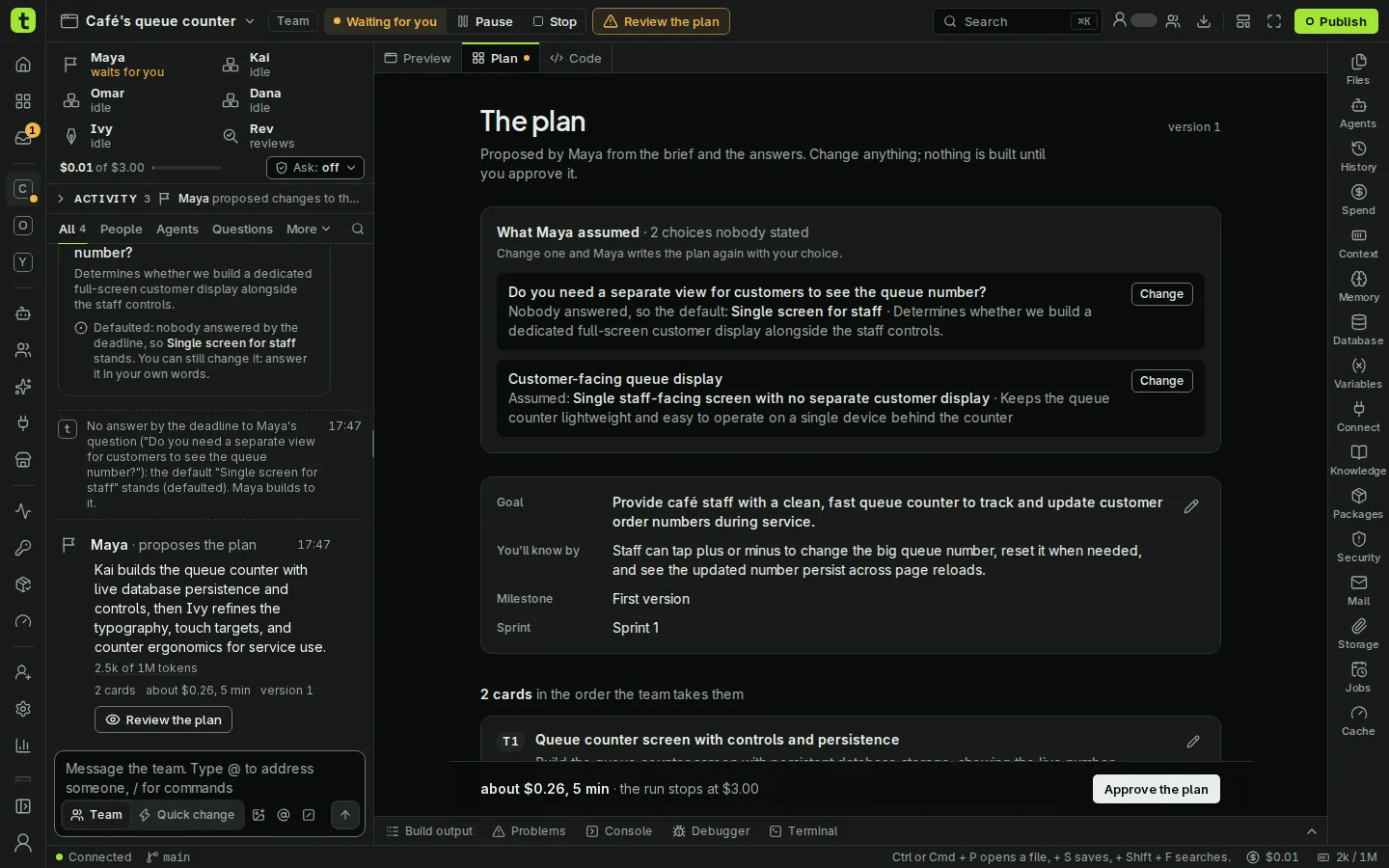
On an unclear brief, Maya, the lead, asks what she needs. Each question has options, a default and a 2-minute deadline; what nobody answered is listed as an assumption you can change.
Then the plan: the goal and how you will know it is met, a milestone, a sprint, and cards in order with acceptance criteria, owners, dependencies with reasons, cost, time and a hard stop.
Every card must carry at least one acceptance criterion: the database enforces it. The lead never writes code. Nothing is built until you choose Approve the plan; Plan again replaces only cards never started.
F-13, F-14
Code decides whose turn it is
Specialists take turns in board order. A coordinator written in plain code reads the database rows; it is never a model.
A turn: intent, work, proof, restore point
Each turn opens with the agent saying what it will change and why; its write tools refuse until it has. At the end a gate runs the type-check and loads the app in a real browser on a desktop and at phone width. The turn ends in a git commit, so every step can be restored.
- Limits per turn
- 15 steps, 5 minutes, US$0.40
- The first-version card
- 25 steps, 8 minutes, US$0.80
- The gate
- Type-check, then desktop and 390 px in a real browser
- The end of a turn
- A git commit you can restore
F-15
Handoffs with real context
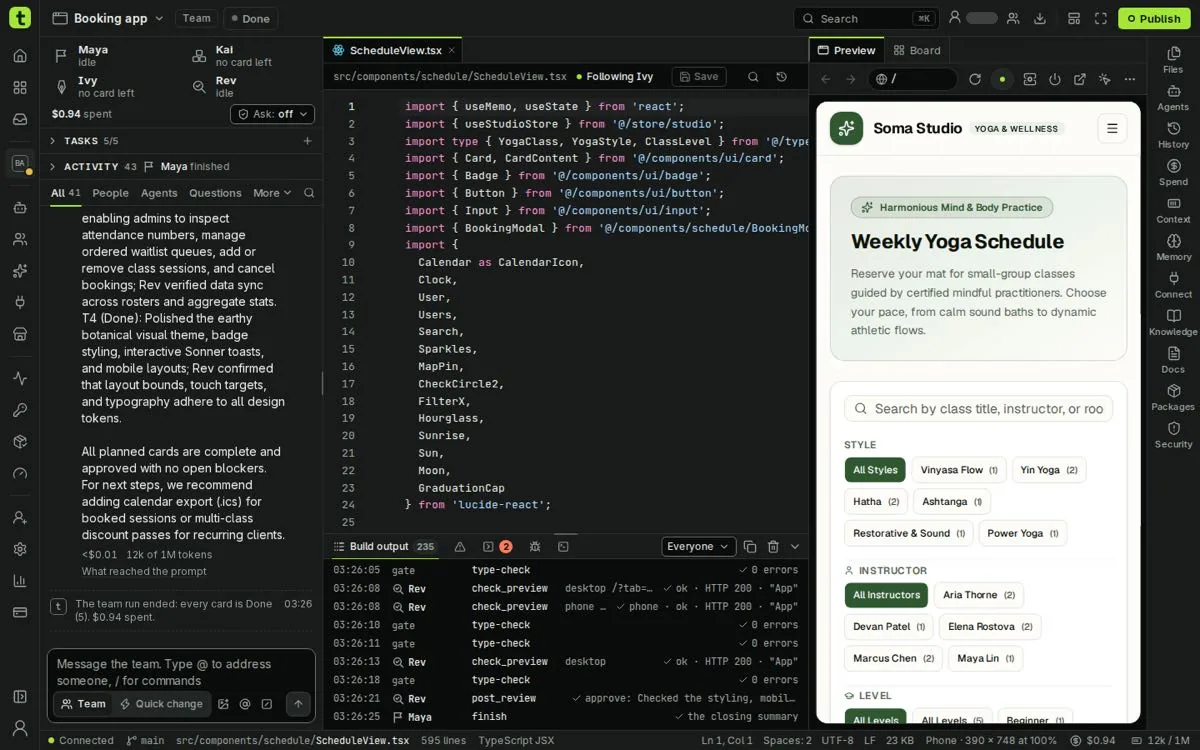
When the next card belongs to another agent, the finishing agent must hand off: what was built, which files, what to watch out for, and the gate's evidence (type-check, desktop, phone, commit, cost).
The handoff goes into the next agent's prompt. Scenario C02 plants a fact in T1's handoff and finds it in T2's prompt and code.
- PASS a fact planted in T1's handoff found in T2's prompt and code (C02)
F-16
Agents ask each other, and ask you
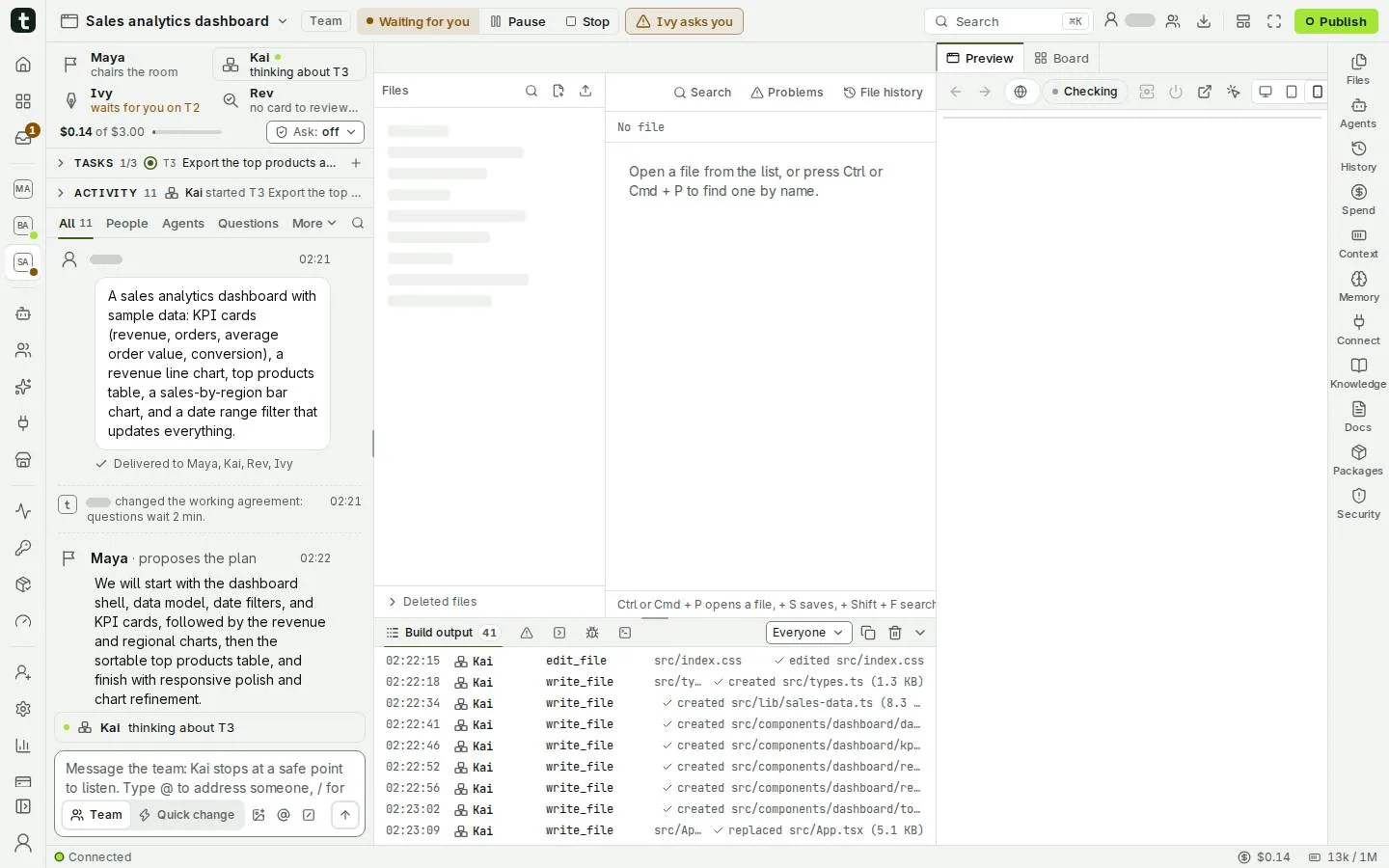
An agent can put a question to a teammate (one bounded reply, delivered into its next step) or to you, with options, a default and a deadline.
Only that card waits; the rest of the team keeps building. An unanswered question is recorded as defaulted, never as answered, and can be changed later.
- 12 of 12 runs where agents asked each other and the person (C03, C08)
F-17
When you speak, everyone stops and listens
Write in the room at any time. Tennet reads what kind of message it is, and code, not a timer, decides what happens next.
| Kind | For example | What happens |
|---|---|---|
| Answer | A reply to “Ivy asks you” | Goes to the agent that asked; only its card was waiting. |
| Ask | “@Kai what are you working on?” | Answered by those named while work continues. |
| Direct | “Members can join a waitlist when a class is full.” | The writer stops at its next safe point; the agents reply in turn; the lead proposes changes. |
| Discussion | A question about the plan itself | The same: the writer stops, everyone replies in turn, the lead proposes last. |
The rules, as code
- Nothing new starts within 2 seconds.
- The writer stops within 15 seconds; files are only ever written whole, and the work so far is saved as a commit.
- The agents reply in turn, each seeing the replies before it; the lead, last, proposes typed changes to the plan.
- Changes appear on the board as dashed ghost cards with their cost.
- A change that edits no card and adds at most US$0.20 carries on at once; anything else waits for Apply, Edit, Keep plan or Stop.
- No timer ever decides.
- 0.2 s for the room to give a person the floor
- 4.2-10.8 s for the writing agent to stop when a person speaks
- 572-980 ms for an accepted change of plan to reach the board
View as table
| Measure | Value | Bar |
|---|---|---|
| Floor held | 0.2 s | 2 s |
| Writer stopped, promotion | 4.2 s | 15 s |
| Writer stopped, round 8 read | 10.8 s | 15 s |
| Change reached the board | 572, 607, 980 ms | 2,000 ms |
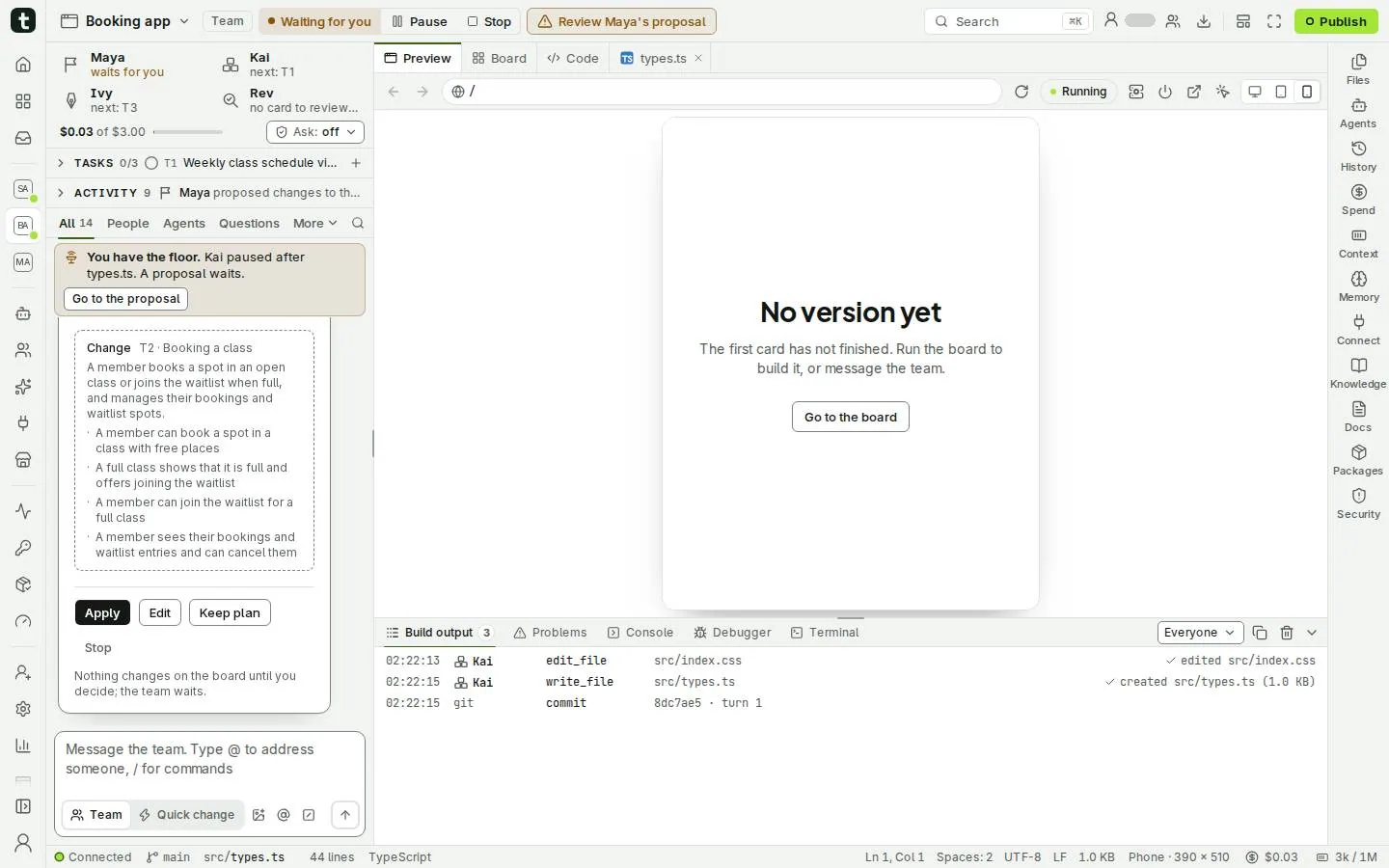
- 1Maya waits for you. The lead has proposed a change; the team waits.
- 2You have the floor. Kai paused after types.ts. A proposal waits.
- 3A typed change. T2 rewritten with four acceptance criteria that bring in the waitlist.
- 4You decide. Apply, Edit, Keep plan or Stop. No timer ever decides.
F-18
Review that talks back, QA tests, and an honest Done
A reviewer reads each card's diff and checks both screen sizes. Findings go into the author's next prompt and it revises in the same run; after two rounds, you decide. Review levels are light, standard or strict. Reject restores the card's files to its base.
On Squad teams Quinn turns each card's criteria into tests before review, and Tennet runs them by code. An unreadable verdict never counts as an approval.
- PASS a planted phone defect found, reported and fixed in the same run (C04)
A card is Done only when
- the gate passed: type-check, desktop and phone
- the review approved it
- at least one file changed
- no write was cut off
- you accepted it, where the team's policy asks
F-19
Pause, Stop and recovery
The state lives in the database: a reload or a second tab shows the same discussion, question and approval.
Pause
Stop
Recovery
F-11
Templates and seats
A template seats the team; the stack brings its specialists; the working agreement sets how the team works with you.
Starter
Squad
Agency
Specialists the stacks bring
Omar (backend) and Dana (database) on full-stack teams; Lena (writer) and Hugo (analyst) on Documents teams; Rio on phone apps; Sena in the site-reliability seat.
Default caps per team
- A turn
- US$0.40
- The first-version turn
- US$0.80
- A run
- US$3
- A discussion round
- US$0.20
| Setting | Choices |
|---|---|
| Approval policy | Off, each card, or before publish |
| Question deadline | 2 minutes by default (1 to 10) |
| Review level | Light, standard or strict |
| Caps | Per turn, per run, per discussion round |
| Cards at once | One by default; lanes as an opt-in |
| The QA seat | On or off |
| The resume rule | How a paused or parked run carries on |
F-34
Several cards at once, and an honest miss
“Cards at once” above one gives each card its own lane: a copy of the app with its own preview and branch. A merge queue joins one change at a time under the gate; a conflict goes back to its author.
View as table
| Measure | Measured | Bar | Result |
|---|---|---|---|
| Run 1 | 80 % | at most 70 % | Missed |
| Run 2 | 87 % | at most 70 % | Missed |
| Run 3 | 84 % | at most 70 % | Missed |
Three runs read 80, 87 and 84 % of one lane's time, at 16 to 25 % more cost. The bar was missed.
So one lane stays the default, and Tennet makes no speed claim for lanes. They remain an opt-in for people who want them.
Questions people ask
Not answered here? Write to [email protected].
Who chooses the agents?
You pick a template (Starter, Squad or Agency); the stack brings its specialists, and the lead can propose hires for roles its plan needs, shown in full before anyone is hired. Nothing starts before you approve.
Can I talk to the team while it works?
Yes. Write in the room at any time: an ask is answered while work continues; a direct instruction or a discussion makes the writer stop at a safe point, and everyone replies in turn. See When you speak.
What does a team run cost?
The plan shows its estimate and a hard stop before you approve. At the phase 1 exit read the median team build cost US$0.287. Every line shows its cost, and caps hold before each call.
Can two people work in one room?
Yes. Each sees the other, every instruction is attributed by name, and conflicting instructions raise a conflict card both see (23 of 23 checks, scenario C13).
Do agents write code at the same time?
One writer changes the code at a time. Lanes let several cards run at once as an opt-in, but the speed bar was missed, so Tennet makes no speed claim for them. See Several cards at once.
What happens if something crashes?
Every turn ends in a commit. After a crash the run resumes from the database with nothing done twice; scenario C10 kills the worker mid-turn every verification and finds 0 steps doubled.
Related
The Theatre
The board
Agents, teams and skills
Join the waitlist
Tennet is in private preview. Leave your e-mail and we'll write when sign-up opens.
Contact us about anything else.